
Seven-axis chain
J1 base yaw; J2 shoulder pitch; J3 longitudinal roll; J4 elbow pitch; J5 roll; J6 wrist pitch; J7 wrist roll. Frames, joint order and limits need a reviewed hardware mapping.

Cheverton Holdings LLC
A seven-axis manipulator design study for Cheverton Robotics medical-supply assistant development.

CHEVERTON / ROBOTICS
HCR-1 / ARM DESIGN STUDY
A proposed arm-module reference for the HCR-1 dual-arm mobile medical-supply assistant. The revised platform pairs two manipulators; this historical seven-axis chain is a candidate for each arm, pending coordinated workspace, load and collision review. This exploded reference separates the serial chain, cartridge families, covers and power/data harness so interfaces can be reviewed before fabrication.
Development status: engineering preparation. Component selection, fits, joint limits, payload and reach remain unvalidated.
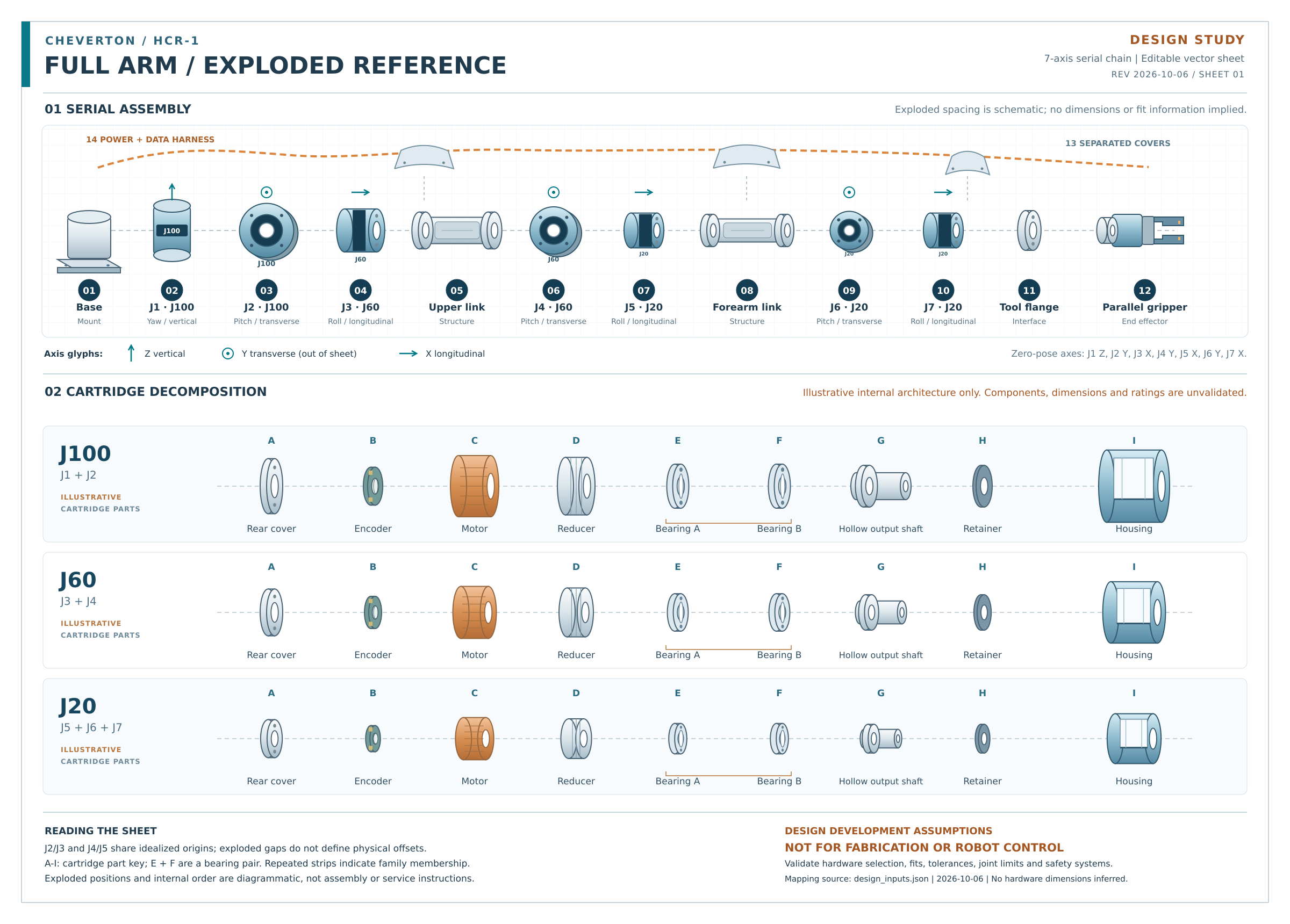
J1 base yaw; J2 shoulder pitch; J3 longitudinal roll; J4 elbow pitch; J5 roll; J6 wrist pitch; J7 wrist roll. Frames, joint order and limits need a reviewed hardware mapping.
Illustrative motors, reducers, paired bearings, encoders, output shafts and housings. Torque, thermal, backlash and service requirements remain engineering decisions.
Machine structural parts where feasible and use 3D-printed covers as nonstructural protection. Traceable stock or used components remain candidates; shop access, condition and quotations need verification.
Define power/data interfaces, stop and fault behavior, and policy-to-controller rejection cases. Independent protective functions and qualified engineering review remain separate gates.
Next evidence: measured mass and geometry, reviewed loads and stability assumptions, component documentation, CAD/tolerances and an independently reviewed bench plan.