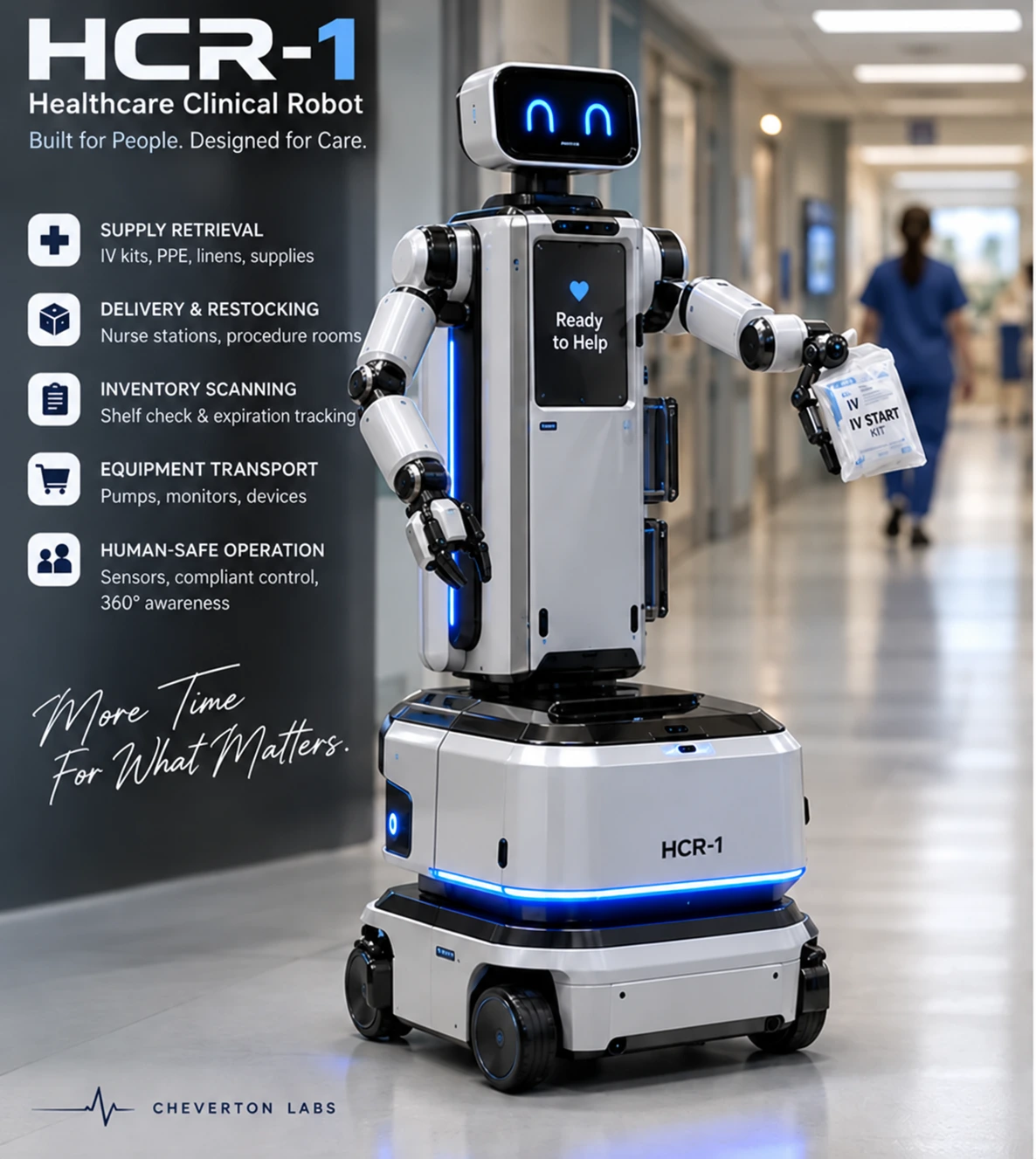
A medical-supply assistant concept: mobile base, dual arms, storage and sensing, with validation still open.
CHEVERTON / ROBOTICS
Dual-arm mobile concept. AI-generated design illustration, not a photograph or engineering drawing. No physical prototype has been built. Open the concept render.
HCR-1 / DUAL-ARM MOBILE CONCEPT
Two arms. One mobile platform.
Head
Display for status and simple communication
Two arms
Paired shoulder-mounted manipulators with parallel grippers; joint count and geometry remain under review
Tower
Central storage cabinet for packaged supplies, with clear door access
Mobile base
Low wheeled platform with proposed obstacle sensing and docking; drive architecture remains open
Status: revised design study. Dual arms on a mobile base are the selected concept direction; dimensions, ratings and safe operation remain unvalidated.
HCR-1 / MEDICAL-SUPPLY ASSISTANT CONCEPT
A supply platform. A clear first task.
Explore packaged-supply retrieval and restocking from known storage locations in a controlled workflow. The concept combines a mobile base, two coordinated manipulators, storage module and sensors. Customer demand and workflow benefit still need evidence.
Development status: prototype planning and internal engineering drafts. The first feasibility scope excludes patient care, medication administration and clinical actions.
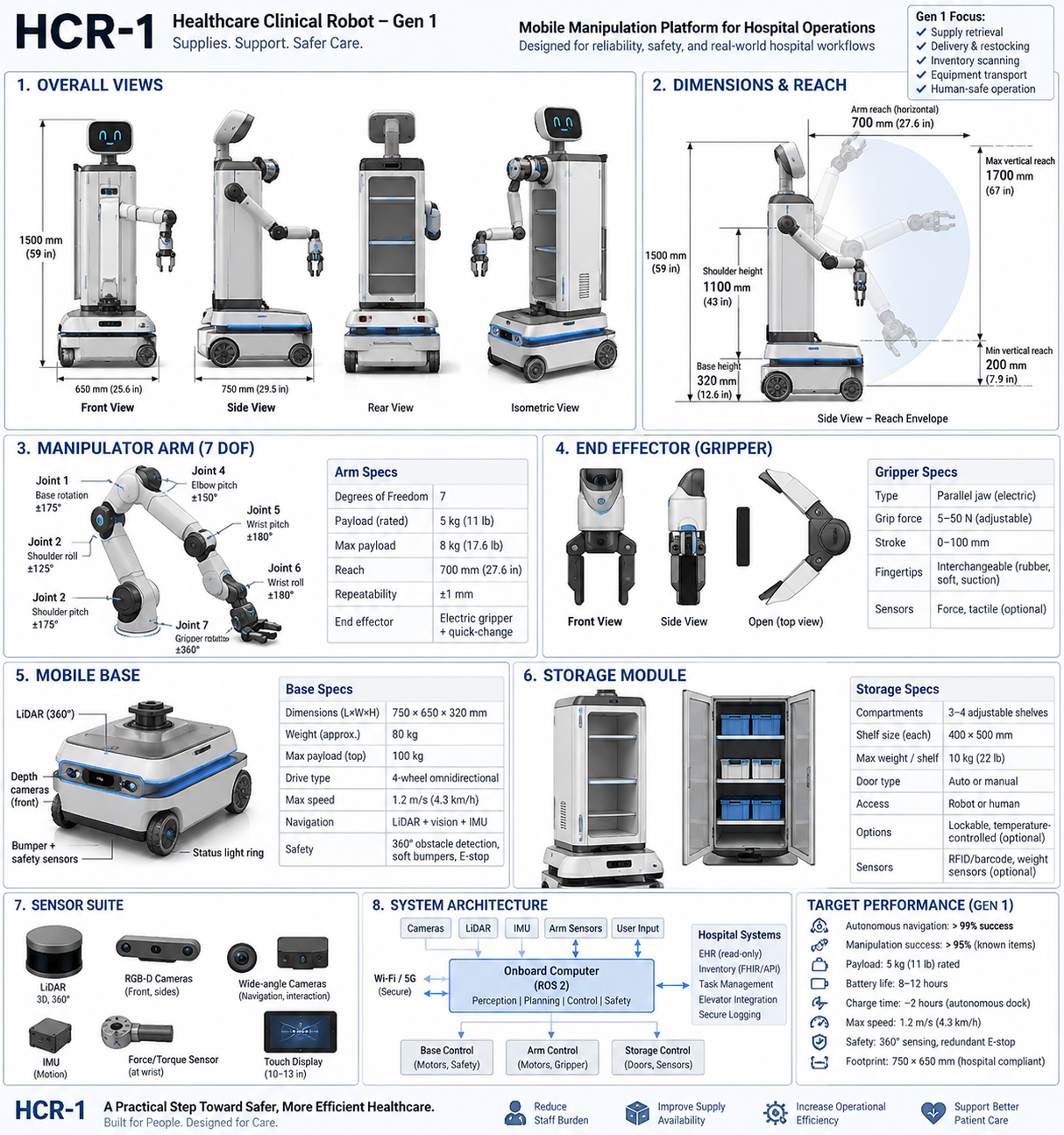
Historical single-arm reference, superseded by the dual-arm direction. Its printed performance, payload, safety and hospital-compatibility statements are unvalidated design targets. They are not measured results or approved specifications.
Original HCR-1 concept blueprint. Proposed interfaces and targets require revision and qualified review. The arm's current exploded reference is on the Arm page. Open the full-resolution schematic.
Mobile base and stability
Review drive architecture, stopping behavior, docking, both arms at maximum extension, asymmetric loads and tipping cases. Plan an arms-stowed travel mode; manipulation with the base stopped is the initial design assumption. Speed, endurance and payload limits must be established from selected hardware and tests.
Dual arms and storage
Coordinate both manipulators, grippers and supply shelves around a defined task. Assess arm-to-arm collision, shared workspace, dropped-object hazards and unobstructed cabinet access. Reach, retention, access, cleanability and nonstructural printed covers remain design questions.
Perception and controls
Prepare camera, state and action interfaces; version scenarios, provenance and fault tests. The schematic's hospital-system links are proposed integrations, not connected services.
Cost and customer evidence
Compare simpler manual/fixture alternatives, traceable stock or used parts, labor, maintenance and compute costs. No inspected inventory, approved budget or validated customer benefit is implied.
Next evidence: an intended-use and workflow baseline, reviewed dual-arm/base geometry, traceable BOM, simulation/test plan and qualified safety/classification review before physical or customer work.